
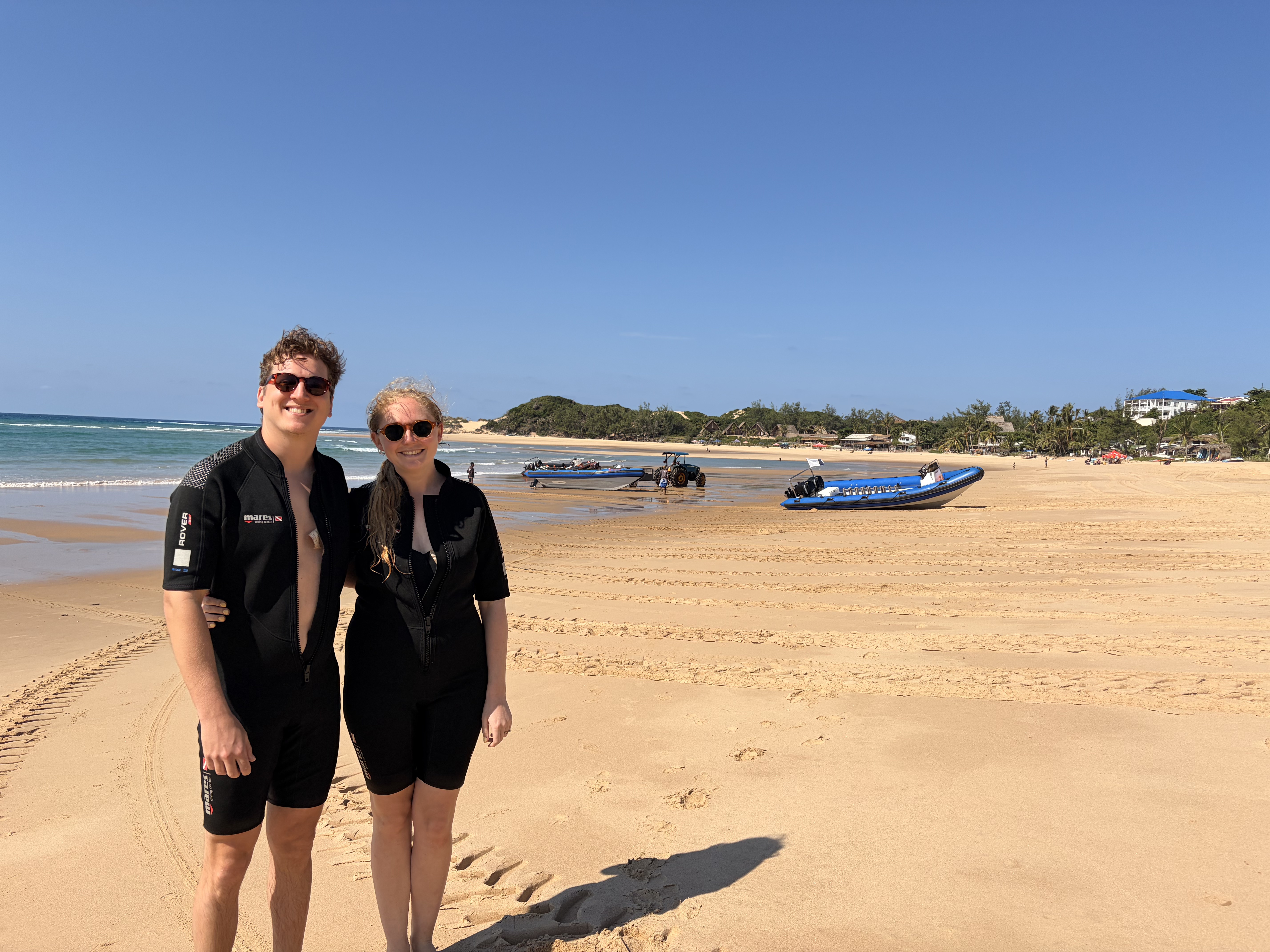
Whale sharks, manta rays, humpback whales and reefs that feel almost untouched, all on a coastline that still has dusty beach towns and shacks on the sand instead of big resorts.
A week is plenty for a proper dive trip here. This guide covers how to get there, where to base yourself, what you can see underwater and when, and how we’d spend seven days if you only have limited annual leave.
📅 When to go
May–November
✈️ Fly to
Maputo (MPM) → Inhambane (INH) or fly to Vilankulos and drive
💰 Daily budget
From ~$50 USD/day
Why Mozambique
Some of the best diving we’ve ever done
Tofo Beach is the diving heart of southern Mozambique. Mozambique has a hard recent history, and tourism is now helping the country as it opens up. The diving blew our minds, and the towns are still small, dusty and unpolished, which is a big part of the charm.
Tofo sits near the edge of the continental shelf, where warm Indian Ocean water meets the cooler Mozambique Channel, which helps explain the variety of life: manta rays, whale sharks, dolphins, humpbacks and several species of shark.
Our advice: You don’t have to be a diver to enjoy Tofo. There’s surfing, whale watching, snorkelling trips and islands with beaches covered in starfish. But diving is the main reason to be here.
When to visit
Whale sharks can be seen all year, but the best chance is in the warmer months, roughly November to April or May. Manta rays are generally seen in greater numbers from about October to April. From around June to September, humpback whales pass close to shore (you can even spot them from the dunes). Ponta do Ouro is known for its sharks, with December to May often suggested as a good window.
The dry season (roughly May to November) brings sunny weather and clear skies. The rainy season (roughly December to April) is more humid, with a chance of cyclones. Check conditions for your dates, because there’s no single perfect month: it depends which animals you most want to see.
How long do you need?
Three or four days in Tofo is enough for a dive-focused break, and a week lets you add Vilanculos and the Bazaruto Archipelago. If you want Ponta do Ouro and Kruger as well, you’ll want 10 days or more.
Getting there
Skip Maputo, fly to the coast
Maputo is the capital, but we wouldn’t spend time there. The city is still up and coming, and several people warned us to be careful, even for the short walk from our hotel to dinner. Everyone we met seemed friendly, but there isn’t much to see or do, and the real charm is on the coast. A transfer from Maputo to Tofo takes seven hours or more.
✈️ Fly to Vilanculos
There are easy flights up to Vilanculos from Johannesburg. Vilanculos is a great dive destination in its own right, and a good place to start.
🚗 Vilanculos to Tofo by private driver
The place we stayed arranged a driver to take us down to Tofo. He was waiting for us, the roads were mostly tarmac the whole way, we took one small detour, and it all felt safe and easy. Expect roughly 4-5 hours.
✈️ Daily budget
Inhambane is the closest airport to Tofo, so it’s ideal if you only want to dive in Tofo and don’t have time for Vilanculos
💵 Cash matters: Much of Mozambique still runs on cash, and our driver would only take cash. We got money out on the way down, and do be prepared as we had to queue to get the cash. There’s no cash machine in Tofo itself, and while more restaurants are starting to take cards, it’s not something to rely on. If you run short you’d need a lift to Inhambane. Don’t rely on airport ATMs either, as there are none at Vilanculos Airport.
🎟️ Check your visas: Check what your passport needs before you book. At the time of writing, most countries can get an Electronic Travel Authorisation (ETA) up to 48 hours before flying to Mozambique (and probably closer to the date, ours came through within 30 minutes). Rules can change so check with your countries official portal
Where to stay
Fly into Maputo and connect to Inhambane. The short domestic hop takes under an hour. Arrange a transfer to Tofo — guesthouses will often pick you up — check in, eat seafood on the beach, and sleep off the journey.
🐋 Top tip: Book your whale shark snorkelling through your accommodation or direct with an operator like Peri Peri Divers or Diversity Scuba, both have strong reputations and high sighting rates. Don’t book through a hotel middleman; the price is the same and the quality varies.
First day in Tofo
Back-to-back dive days at Tofo’s famous sites. Manta Reef is the must-do — a cleaning station where huge oceanic mantas glide in to have parasites removed. The dives here are typically at 15–25 metres and the encounters are extraordinary. You’ll also want to hit Giant’s Castle and Sherwood Forest, two dives packed with schooling fish, soft corals, and regular reef shark sightings.
Where to stay in Tofo
Liquid Dive Adventures is a great place to stay in Tofo, especially if you want accommodation close to diving and the beach. There is a real range in accomodation, from what I saw it was either much lower quality in real life, and quite dirty, or incredibly expensive. Although slightly more on the expensive side the accomdation was so lovely and worth spending a little extra. I would recommend eating out, although the food was good it was alot more expensive than other places in the town, and there is so much good food.
Most dive operators are within walking distance of all accommodation in Tofo, so location matters less than budget and vibe. Backpackers and budget lodges cluster around the main beach strip; the smarter lodges sit slightly back from it on the dune ridge.
Most operators in Tofo run dedicated whale shark snorkelling excursions — and the success rate here is genuinely one of the best in the world. These gentle giants congregate in the waters off Tofo in reliable numbers, and snorkelling alongside one is a bucket-list moment that’s hard to top. (You can dive with them too, though snorkelling is the standard approach and considered less disruptive.)

The big picture
Use these days to explore. Take the short ferry across to Inhambane city for its colonial-era architecture and excellent market. Or arrange a daytrip north towards Barra, another excellent beach spot with its own dive sites and famous mantas.
Transfer south
Head back to Inhambane for your connection to Maputo, and then onward home. If your schedule allows an extra day in Maputo, it’s well worth exploring — the seafront Baixa district, the Central Market, and the extraordinary Polana neighbourhood are all worth a few hours.
Where to dive in southern Mozambique
| Location | Best For | Typical Depth |
|---|---|---|
| Tofo — Manta Reef | Manta rays, reef fish, whale sharks | 15–25 m |
| Tofo — Giant’s Castle | Big schools of fish, reef sharks | 18–28 m |
| Tofo — Sherwood Forest | Soft corals, moray eels, macro life | 12–22 m |
| Barra | Mantas, turtles, open-water fish | 10–25 m |
| Bazaruto Archipelago (Vilanculos) | Pristine coral, dugongs, dolphins | 5–30 m |
Beyond diving, Tofo is one of the best spots in Africa for whale watching between June and November, when humpback whales migrate along the coast. Several operators combine whale watching with their morning dive charters, making it easy to tick both boxes in a single trip. The dhow sailing trips at sunset are equally worth your time — a traditional wooden sailing boat, cold drinks, and the Indian Ocean turning gold.
Practical tips for diving in Mozambique
- Best time to visit: May to November for clearest water and whale shark sightings. December to April is warmer but can bring rain and rougher seas.
- Certification required: Open Water PADI or equivalent for recreational dives. Most operators offer try-dives for beginners.
- Cost of diving: A single fun dive in Tofo typically costs around $30–$40 USD. A five-dive package works out cheaper and is the better value.
- Whale shark snorkel trip: Budget around $40–$60 USD per person for a dedicated excursion.
- Accommodation: Tofo has guesthouses, beach lodges and backpacker hostels ranging from $15 USD per night for a dorm to $80–$150 for a private beach-facing room.
- Getting there: Fly to Maputo (MPM) and connect to Inhambane (INH) on a domestic flight. TAM Mozambique and LAM Mozambique both operate the route.
- Visas: Many nationalities can obtain a visa on arrival. Check your country’s specific requirements before travel.
- Currency: Mozambican Metical (MZN). US dollars are widely accepted in tourist areas. Carry cash as ATMs can be unreliable.
- Malaria: Mozambique is a malaria zone. Speak to your GP before travel and take appropriate precautions (prophylaxis, repellent, long sleeves at dusk).
- Dive insurance: Always dive with appropriate insurance. DAN (Divers Alert Network) cover is strongly recommended.
How to maximise your annual leave to get to Mozambique
This is where it gets interesting for the Annual Leave Explorers community. Mozambique is a long-haul destination, but with smart planning you can squeeze a genuinely epic trip into a standard week of annual leave. The key is the routing: most direct flights from Europe to Maputo go via Johannesburg or Nairobi, and travel times are comparable to flying to South-East Asia.
How to maximise your annual leave in Mozambique
Here are three ways to fit Mozambique into your leave.
3–4 days
Fly into Inhambane or transfer to Tofo and dive: a couple of reef dives, plus a whale shark or manta trip.
7 days
Add Vilanculos and a Bazaruto day trip, and the advanced course in Tofo.
10+ days
Add Ponta do Ouro for sharks, then a safari in Kruger.
Is Mozambique worth it for a dive trip?
Absolutely, yes — and it’s not even close. Mozambique offers some of the best diving in the Indian Ocean at a fraction of the price of the Maldives, with genuinely extraordinary marine life, warm hospitality, and an adventure-travel energy that’s hard to find in more polished destinations. The infrastructure has improved enormously in recent years, making it more accessible than ever, while the beaches and reefs still feel refreshingly unspoilt.
⚓ Operators to note: Tofo Scuba and Peri Peri Divers both offer excellent PADI courses on-site if you want to get your Open Water certification here rather than at home — and there are few better places to learn.
Whether you’re a seasoned diver chasing manta rays or a curious traveller thinking about getting your Open Water certification somewhere spectacular, Mozambique will exceed your expectations. Book it.
Planning Your Trip
When to visit
Whale sharks can be seen all year, but the best chance is in the warmer months, roughly November to April or May. Manta rays are generally seen in greater numbers from about October to April. From around June to September, humpback whales pass close to shore (you can even spot them from the dunes). Ponta do Ouro is known for its sharks, with December to May often suggested as a good window.
✈️ Getting There
Fly into Maputo (MPM), then connect to Inhambane (INH). Journey time from the UK is typically 13–15 hours including connections via Johannesburg or Nairobi.
📅 Best Time to Go
May to November for best visibility, whale sharks, and whale watching. Peak whale shark season is October–November.
💰 Budget Guide
Fun dive: ~$35 USD. Whale shark trip: ~$50 USD. Budget guesthouse: from $15/night. Mid-range lodge: $80–$150/night.
YOUR MOZAMBIQUE ADVENTURE
A week diving in Mozambique
We only had three days in Tofo, so this is the week we’d plan with the benefit of hindsight. Swap days around depending on weather and sea conditions.
Day 1 · Arrive
Fly into Vilanculos
Flights
Beach lodge
Fly in from Johannesburg, collect cash before you leave anything to chance, and settle into a lodge on the beach. Like every Mozambican town we saw, Vilanculos is small and dusty with shacks on the beach, and that’s part of its charm.
Day 2 · Bazaruto day trip
The Bazaruto Archipelago is Mozambique’s dedicated marine national park and home to some of the best-preserved reefs in the country, and it’s also known for its dugongs. You don’t have to stay on the island: you can dive and visit on a day trip from Vilanculos, which is far cheaper than a long stay.
You can stay on Bazaruto Island for a truly unforgettable experience; there isn’t anything on the island but wilderness, and you may find affordable accommodation. Getting there is expensive, we were quoted $500 each way, and this was the cheapest we could find.
Day 3 · Road
Drive down to Tofo
Private transfer
Cash
Arrange a driver through your accommodation. Take cash out on the way and settle into Tofo with an evening in town, because there’s plenty to eat. Your first night can be lively: when we arrived there was a party on and locals were drinking and dancing in the street.
Day 4 · Reef
First dives in Tofo
Diving
Courses
Even the shallower reefs, at around 12 metres, are beautiful. I’ve never seen so much marine life. If you’re not yet an advanced diver, this is the day to start your course.
Our tip: The manta ray sites are deep, so you need the advanced qualification to go below 30 metres. I did the adventure course while I was there. It takes two days, so you can fit it into a short trip, and the course dives are done at the 30m sites.
Day 5 · Deep
The big animals
Manta rays
Whale sharks
Complete your advanced dives, or head out on a boat trip to look for whale sharks. They’re mostly found near the surface, so you can swim with them, which makes it an extremely unique experience.
Day 6 · Slow down
Beach, snorkelling and surf
Snorkelling
Surfing
Rest your lungs: you shouldn’t fly straight after diving, so keep this as a non-diving day. Visit an island with more starfish than you can imagine, take a snorkelling trip, go surfing, or take a whale-watching tour in season. If you like the beach, spend the day there. The town is small and there isn’t a lot more to do, which is the point.
Day 7 · Home
Transfer and fly out
Travel
Book a transfer from your accommodation to the airport in advance. Ours organised it for us, and it was far easier than arranging it ourselves. Leave plenty of buffer before your flight.
Pro tip: Add Ponta do Ouro
If you have a few extra days, a classic route is Vilanculos for a couple of days, then Tofo, then Ponta do Ouro in the far south for a couple of days, flying out of Maputo. Ponta do Ouro is known for sharks. It’s another advanced-diver destination (30–40 metres), so get your qualification in Tofo first. Remember Tofo to Maputo is a long road transfer, so this works best with 10 days or more.
Whichever window fits your annual leave, Mozambique will give you more than you expect. The diving is world-class, the pace is relaxed, and the coast still has an unhurried quality that’s rare in more established destinations. Pick the option that suits your time, book your dives in advance, and let the Indian Ocean do the rest.
AN EXTRA IF YOU HAVE TIME
Combine it with Kruger
From the south of Mozambique you’re a short journey from Kruger National Park, and a lot of people combine the two. A week diving followed by a week on safari is an incredible trip.
Read our guide: Affordable Safari Adventures: Explore Kruger National Park & Beyond.
Related planning guides
- Explore our Africa travel guides for more wildlife, beaches and adventure ideas across the continent.
- Plan a one-week annual leave adventure for a memorable trip that fits neatly into a standard week off.
- Browse our two-week adventure itineraries if you have time to combine Mozambique with more of southern Africa.
- Find more inspiration in our beach holiday guides for relaxed coastal escapes and beautiful shores.
Where to eat in Tofo
The streets in Tofo are small, so you can walk around and find places easily. The food doesn’t always match how a restaurant looks: some of our best meals were in odd-looking places. Check opening hours and card payment before you go.
Dinner
Tchau Chow
Phenomenal, and close to Liquid Dive Adventures. Really recommended.
Lunch
Rio’s Café
Great spots to sit outside and nice, reasonably priced food.
Street food
Street stalls in town
Some great places to eat on the street, and cheaper than eating at your accommodation.
Practical tips for diving in Mozambique
Mozambique is rewarding but remote, so a little planning goes a long way.
- Carry cashBring enough for transfers, meals and tips. Cash machines are hard to find, and none in Tofo itself.
- Get dive insuranceMedical facilities are limited in remote areas, so make sure your policy covers diving and evacuation.
- Plan your advanced course earlyThe big animals are at depth. Doing the course in Tofo is easy and fits in two days.
- Don’t fly straight after divingLeave a long gap between your last dive and your flight home, and follow your dive centre’s advice.
- Check malaria adviceThere’s a risk of malaria across Mozambique, so speak to your doctor or travel clinic well before you go. Check the vaccine requirements for your route too.
- Take care in MaputoAvoid walking at night, and use transfers between your hotel and restaurants.
- Check your accommodationRead recent reviews carefully, especially in Tofo.


Leave a Reply