
The ultimate trip to Namibia, Africa
Namibia in Southern Africa is one of the most extraordinary countries on Earth — a place where vast desert landscapes meet wildlife‑rich savannahs, where roads stretch straight to the horizon, and where travellers can experience Africa in a way that feels both adventurous and remarkably accessible. It is, without exaggeration, one of the easiest countries in Africa and indeed the world to explore independently.
For anyone nervous about driving abroad, Namibia is the destination that changes everything. I’m a cautious driver overseas, yet Namibia’s long, straight tarmac and gravel roads made me feel confident from the moment I left the airport. There’s very little public transport, but that’s precisely why self‑driving is the best way to experience the country. You’re not navigating chaotic traffic or complex junctions you’re simply following wide, open roads through some of the most beautiful scenery on the planet.
Windhoek International Airport is small, calm, and easy to navigate, and hiring a vehicle is straightforward. I recommend Namibia2Go, who offer both standard vehicles and 4x4s with roof tents. A roof tent adds a layer of luxury to camping, but it’s not essential many of Namibia’s best campsites also offer rooms or glamping pods.
This two‑week itinerary is designed to showcase the very best of Namibia: the Namib Desert, Swakopmund’s coastline, Damaraland’s desert elephants, Etosha’s wildlife, and optional extensions into the country’s remote southern regions. You can drive the loop in either direction the experience is equally spectacular.
Day 1: Windhoek A Simple Gateway to Adventure
Windhoek is Namibia’s capital, but it’s not a destination you need to spend time in. It’s functional, safe, and easy, but the real magic lies beyond the city limits. If your flight schedule requires an overnight stay, choose Urban Camp, a leafy, relaxed spot that feels more like a garden retreat than a city campsite.

For dinner, head to Joe’s Beerhouse a sprawling, eccentric labyrinth of rooms, fire pits, and memorabilia. It’s unlike anywhere else you’ll ever go, and it’s the perfect introduction to Namibia’s warm, quirky hospitality.
Days 2–3: Sesriem & Sossusvlei The Namib Desert’s Iconic Dunes
The drive from Windhoek to Sesriem marks your first taste of Namibia’s vastness. As you head south‑west, the landscape opens into endless plains, jagged mountains, and skies so big they seem to swallow the horizon. Sesriem is the gateway to Sossusvlei, Deadvlei, and the towering dunes of the Namib Desert some of the most photographed landscapes in the world.


Where to stay – Sesrim
A luxurious but still affordable place to stay would be Desert Quiver camp (it is glamping pods), right out in the desert its a night you will never forget – https://booking.tpx.gr/7zYwLwX4. For a cheaper camping location look to Souss camping – https://booking.tpx.gr/9ISmKgOz
Most travellers aim for sunrise, when the dunes glow deep orange and temperatures are cool. It’s beautiful but busy. We visited late afternoon both times, and although it was hotter, we had the entire place to ourselves. Standing alone in Deadvlei, surrounded by ancient trees and silent dunes, is an experience that stays with you forever.
Self‑Driving Inside the Park
At the time of writing, you can still self‑drive into the park. The main road is smooth tarmac, but the final stretch to Sossusvlei involves sand driving. It’s manageable if you let down your tyres, use low gear, and maintain steady momentum. If you’re not comfortable, tour companies are readily available. A new law is expected to require guided access in future, so check the latest rules before you go.
Where to Stay between Sesrim and Swakopmund
You can’t go wrong with any of the camps just outside Sesriem. For a perfect two‑night combination, stay near Sesriem on your first night for easy access to the park, then move to Spreetshoogte Campsite or Bushman’s Desert Camp — both unbelievably remote, peaceful, and atmospheric.


The Best Roads in Namibia
The C19 is arguably the best road in the world a sweeping desert highway that feels like driving through a painting. If possible, also drive the C27, Namibia’s most picturesque road, winding through dramatic desert scenery.


Days 4–6: Swakopmund Where the Desert Meets the Atlantic
After Sesriem, head north‑west to Swakopmund, a charming coastal town with German colonial architecture, sea breezes, and excellent food. The 5‑hour drive is beautiful, passing through changing desert landscapes before reaching the cool Atlantic coast.
Swakopmund is far nicer than Walvis Bay, so base yourself here. Stay north of town along the coast, where the air is fresh and the views are endless.
Where to stay
- Nice hotel centre of town – https://booking.tpx.gr/3zbCHmW6
- Very affordable cheapest option in a great location – https://booking.tpx.gr/sFwsShK6
- 2 bedroom apartment centre of town, midrange price – https://booking.tpx.gr/igo2h9SS
- 3 bedroom apartment on the beach slightly out of town – https://booking.tpx.gr/swijbwcv
Sandwich Harbour
Sandwich Harbour is one of Namibia’s most extraordinary experiences. It’s where the towering dunes of the Namib plunge straight into the ocean, creating a dramatic meeting of sand and sea. On the drive, you’ll see pelicans, flamingos, seals, and sweeping coastal views. It’s exhilarating, beautiful, and unforgettable.


Seal Colony Tip
Most travellers visit Cape Cross, but Pelican Point is the insider secret. It’s smaller, quieter, unrestricted, and free and you can self‑drive or hire a driver. Cape Cross is impressive, but crowded and controlled. Pelican Point feels wild and intimate.
Days 7–9: Damaraland Desert Elephants & Petrified Forests
From Swakopmund, drive 5 hours north‑east into Damaraland, a region of red rocks, dry riverbeds, and desert‑adapted wildlife. It’s rugged, remote, and breathtaking.
Where to Stay
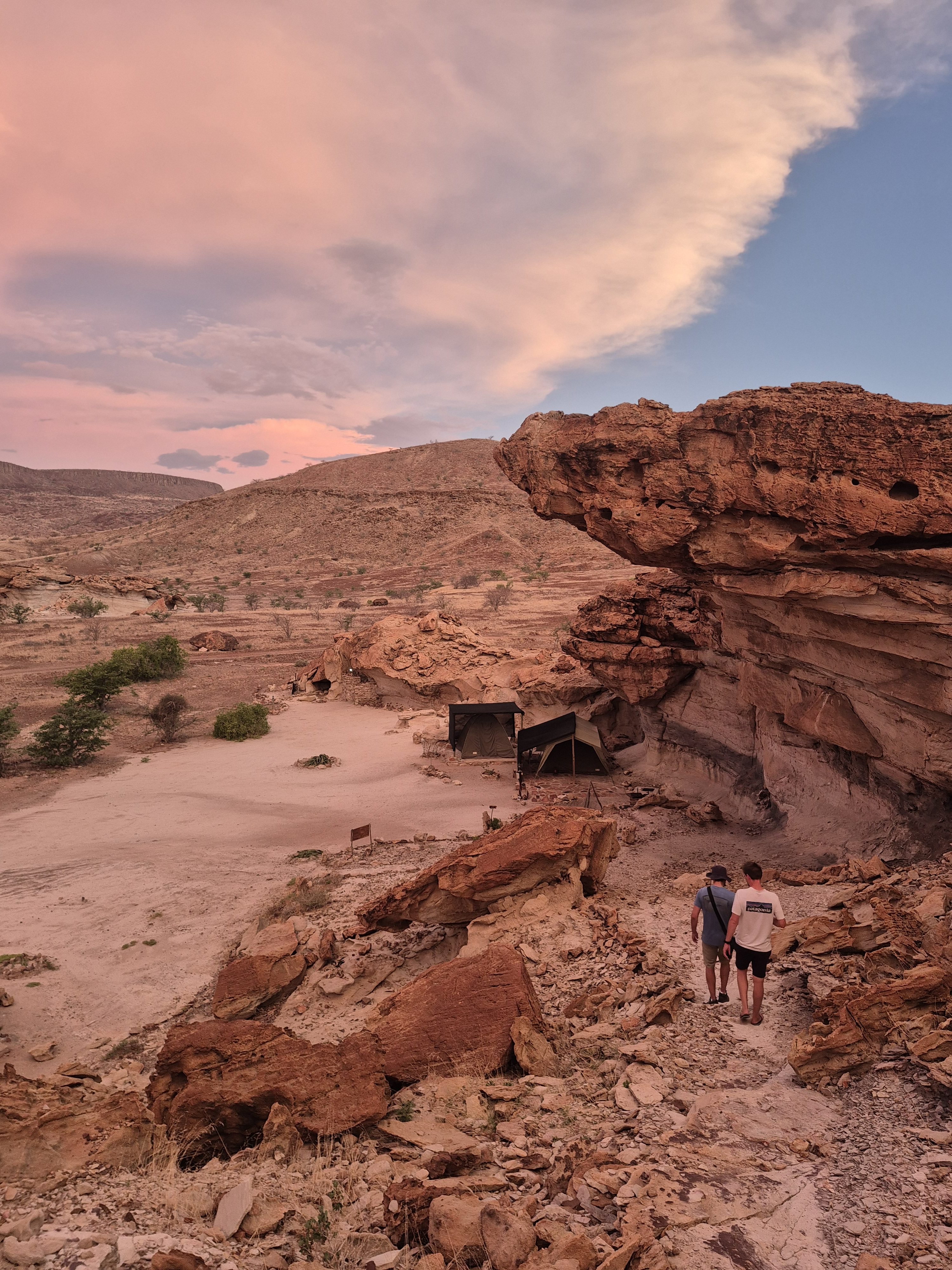
Stay at Tsubes Petrified Forest Tented Camp (photos dont do this place justice online so i have included my own below), one of the most beautiful camps in Namibia. It offers glamping pods, a peaceful desert setting, a swimming pool, and friendly local hosts. We camped there ourselves and there was a good camping pitch.
Desert Elephant Tracking
Ask the camp to arrange a local guide. They’ll hop into your car and take you along the riverbeds where desert elephants roam daily. The locals always know where the elephants are, and driving through dry riverbeds to find these calm, majestic animals is an unforgettable experience.


Tsubes petrified forest tented camp
Days 10–13: Etosha National Park, Wildlife in Abundance
A 4‑hour drive brings you to Etosha, one of Africa’s greatest wildlife destinations. The park is centred around a vast salt pan and is home to lions, rhinos, elephants, giraffes, and huge herds of zebra and springbok.
Fuel Warning
Fill up with fuel whenever you can before you enter the safari park. Even if a camp says it has petrol, it may not. Towns are reliable; remote stations are not.


Where to Stay
The main camp, Okaukuejo, has an iconic waterhole (you can watch their live stream here), but the camp itself is rundown. Instead, stay at private camps just outside the gates such as Etosha Village, Onguma Bush Camp, or Eldorado Guest House & Camping.
Spend your days driving between waterholes wildlife is everywhere, especially in the early morning and late afternoon.
Day 14: Return to Windhoek
The drive back to Windhoek is a straight tarmac road of about five hours. It’s easy, scenic, and simple to complete in a single day.
Optional Extensions for Longer Trips
Namibia’s southern regions are spectacular and far less visited. If you have extra time, consider adding Aus, Kolmanskop, Lüderitz, or Fish River Canyon.
Aus
Stay at Klein Aus Vista Desert Horse Camp, the nicest place we stayed. It offers both rooms and campsites, with sweeping desert views.

Kolmanskop
An abandoned mining town slowly being reclaimed by sand. The guided tour is excellent and atmospheric a photographer’s dream.


Fish River Canyon
Think the Grand Canyon but none of the crowds. This is exploring off the beaten track.
The second largest canyon in the world but no one there. It’s eerily quiet, untouched, and spectacular.


Extra Route Inspiration if you are coming from South Africa
The Richtersveld National Park is worth a visit, with fun off‑road tracks and remote desert scenery. Camp at Pootjiespram.
You can cross into Namibia and drive up the C13 an amazing road through Aus. Then head towards Helmeringhausen, that wonderfully odd little town with the German‑style restaurant.
If possible, get into the NamibRand Nature Reserve and stay at the Family Hideout Campsite. The drive through the reserve is beautiful, and from there it’s a simple journey to Sesriem.
Crossing from South Africa
You can drive from Cape Town to Namibia in one day we’ve done it but staying overnight is more enjoyable, especially during wildflower season.
Border Crossings
- Noordoewer / Vioolsdrif main crossing, open 24 hours
- Sendelingsdrift a quirky pontoon ferry across the Orange River
Best Time of Year to Visit Namibia
I’ve visited Namibia in all seasons, and each offers something different.
Rainy Season (January–March)
Rain usually falls at night, parks are quieter, landscapes are greener, and wildlife remains abundant. Days can be hot, but nights are pleasantly warm.
Dry Season (July–September)
Peak season with clear skies and cold nights (down to –1°C). More visitors, but excellent wildlife viewing.
Top Tips for Namibia
- Fill up with fuel whenever you can
- Buy a local SIM card
- Drive slowly — wildlife crosses roads
- Let down tyres for sand driving
- Carry extra water
- Book campsites early
- Avoid driving at night
- Expect long distances
Packing List
Essentials
Light clothing, warm jacket, hat, sunglasses, sunscreen, rehydration salts, power bank, torch, first aid kit, binoculars, camera, flip‑flops, sturdy shoes.
Camping
Sleeping bag, quick‑dry towel, firelighter, matches, cooler box, extra water containers.
Driving
Tyre pressure gauge, car charger, offline maps, snacks.
For more African adventures look at this page – Africa
Leave a Reply